
Delaware Deed Records
Delaware deed records are public land documents filed at the Recorder of Deeds office in the county where the property sits. The state has three counties. Each one keeps its own set of deeds, mortgages, and liens. Many records go back to the 1600s. Most offices now offer free online search tools. You can look up a name, an address, or a parcel number and see the deed history for any property in the state. This page covers how to search, where to go in person, and what Delaware deed records look like across New Castle, Kent, and Sussex.
Delaware Deed Records Overview
Where to Find Delaware Deed Records
The Recorder of Deeds office in each county is where Delaware deed records live. Each of the three counties keeps its own books, its own index, and its own online system. If the property sits in New Castle County, the deed is filed at the New Castle County Recorder of Deeds at 800 N. French Street in Wilmington. Kent County records are kept at the Kent County Deeds Office at 555 Bay Road in Dover. Sussex County filings go to the Sussex County Recorder of Deeds at 2 The Circle in Georgetown.
Delaware also keeps a state-level archive of old deeds. The Delaware Public Archives runs a deed roaster with entries from 1747 to 2009. This is the place to go for early land grants, colonial transfers, and any deed that got moved out of a county office for long-term storage. The deed roaster lists the grantor, the grantee, the tract name, and the transfer date. You can email archives@delaware.gov for a copy of an original record. Staff will send back a price quote within ten business days.
You can learn more about the history of the state deed system at the Recorder of Deeds agency history page, which traces the office from colonial times to the present. 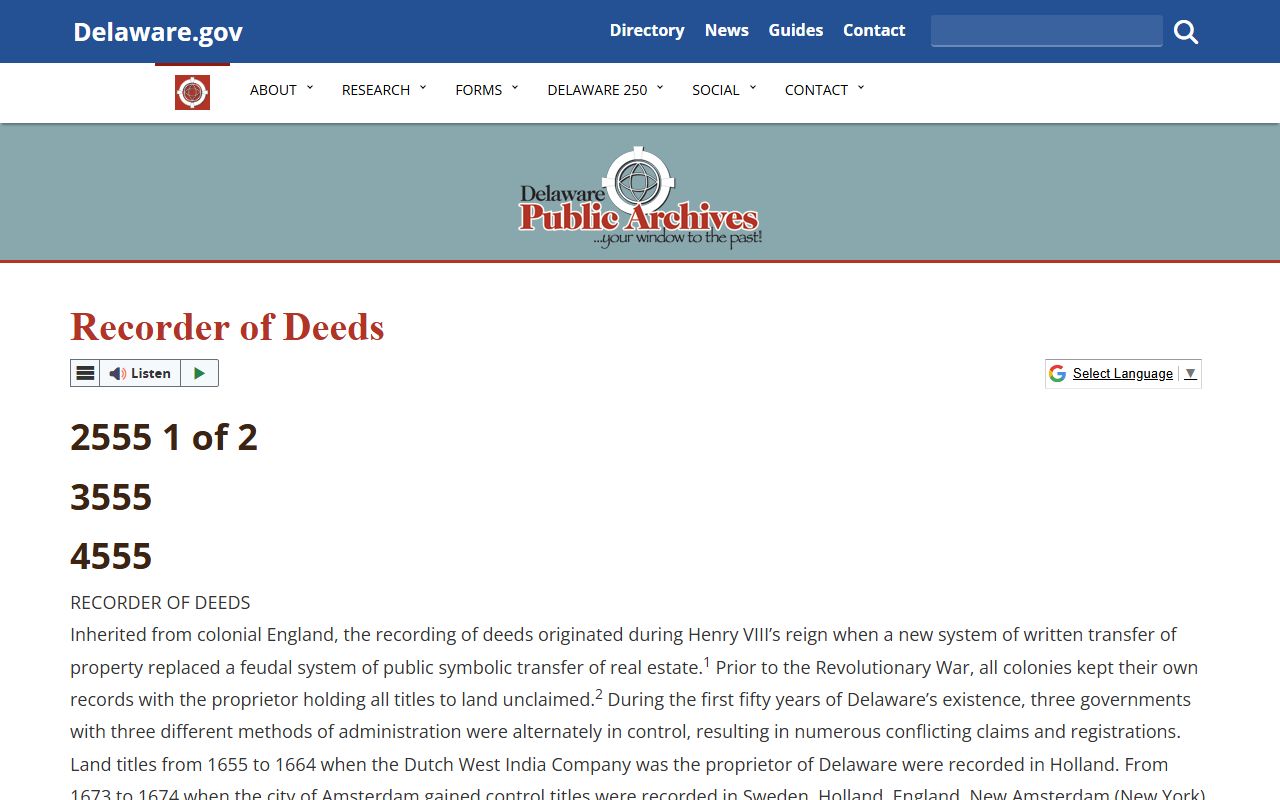 The page explains how the first officially recorded land title in the state is dated 1646, and how William Penn's 1682 Statue of Enrollment set the rule that all land transactions had to be recorded within two months.
Note: Each Delaware county runs its own deed system. File where the land sits, not where you live. A deed for land in Sussex has to go to Georgetown.
How to Search Deed Records in Delaware
All three counties in Delaware offer a free online search for deed records. You can look up deeds by grantor name, grantee name, book and page, or property address. Most of the systems let you view a watermarked copy of the deed at no cost. To print or download, you pay a small fee. Professional title searchers use a monthly subscription plan to skip the per-page fees.
The Delaware chain of title research guide from the state archives is a good starting point for anyone new to the state's land records. The guide walks through each county's online system and explains how to search the deed roaster at the state archives. It also covers what to do if the property spans two counties, which happens in places like Milford.
To search deed records in Delaware, you need:
- Full name of the grantor or grantee (seller or buyer)
- County where the property is located
- Approximate date of the transfer, if known
- Parcel ID or street address, if you have it
- Book and page number for older records
You can also browse the Delaware Open Data Portal for related property data and state records.  The portal hosts over thirty public datasets and thirty-five maps. You can pull up tax information, parcel boundaries, and other public records that tie into the deed search.
Visiting the county recorder office in person is the best option when you need a certified copy or want to look at the full file. The clerk can make copies on the spot. Call first if you want to know what days the office is busy. Many offices close their recording window before the office closes, so plan ahead.
Types of Documents in Delaware Deed Records
A Delaware deed record file holds more than just deeds. The Recorder of Deeds takes all kinds of papers that touch real estate. This includes mortgages, lien releases, leases, easements, and power of attorney forms. Each document gets a book and page number and a note in the index. The recorder then scans the paper and adds it to the public search system. Most records are free to view and searchable by name.
Common documents in a Delaware deed file:
- Warranty deeds and quitclaim deeds
- Mortgage papers and satisfaction pieces
- Federal and state tax liens
- Mechanic's liens and lien releases
- Easements and deed restrictions
- Assignments of mortgage
- Plot plans and subdivision maps
Delaware grants title by deeds that use the words "grant, bargain and convey." This language creates what's called a special warranty of title. It means the seller warrants against title defects that came up during their own ownership, but not before. This is a bit different from a general warranty state. Buyers usually hire a title company or attorney to search the chain of title before closing to make sure no old liens are hiding in the file.
Delaware is an attorney closing state. By law, only a Delaware-licensed attorney can conduct real estate closings and disburse settlement funds. Both the buyer and the seller typically have their own attorney at closing. After signatures, the deed and mortgage get recorded at the county office. Only then does the transfer show up in the public deed records.
Delaware Deed Records Statutes
Delaware deed record law is in Delaware Code Title 9, Chapter 96. This chapter is titled "Recorders" and sets the rules for each county recorder office. It lays out what must be recorded, how records are kept, and what forms the recorder can accept. 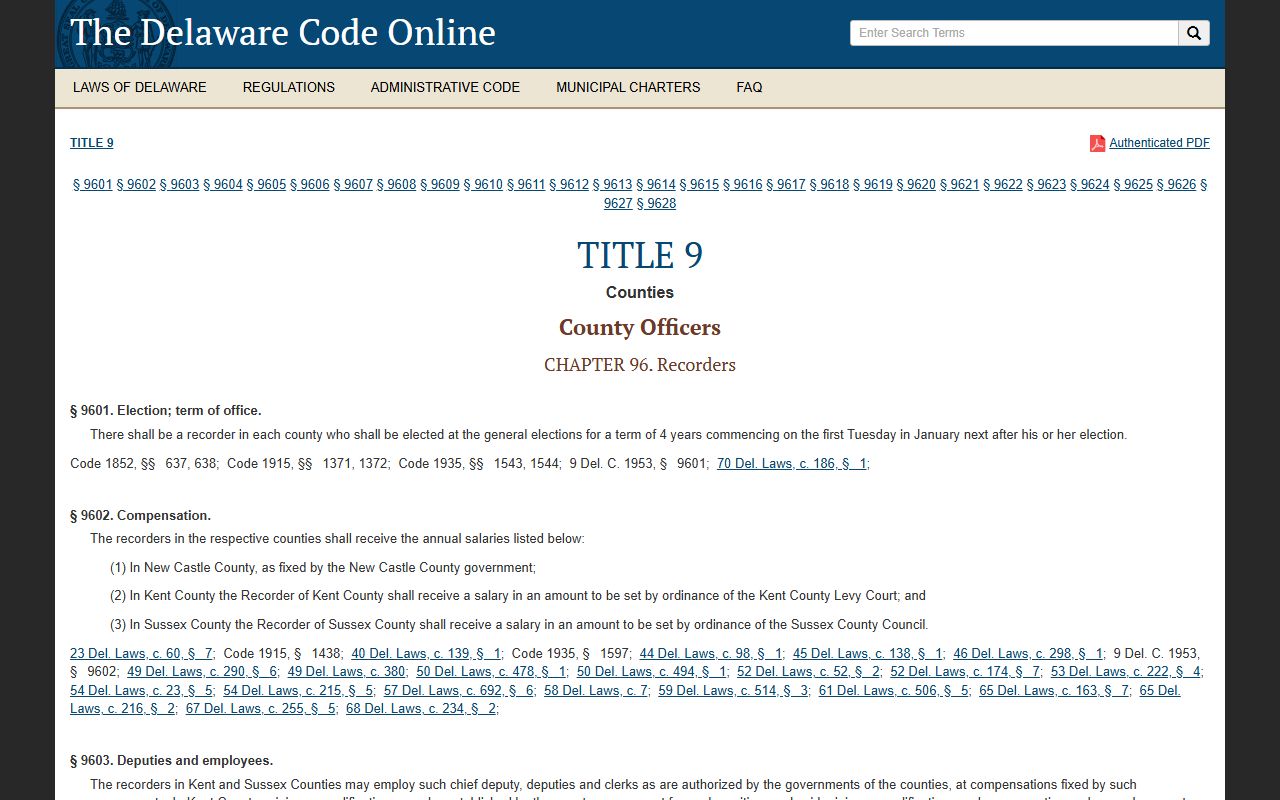 The statute covers deeds, indentures, letters of attorney, mortgages, leases, and every other instrument that affects real property in the state.
Under Delaware Code Section 9605, the recorder must record within a reasonable time all deeds, mortgages, leases, and related instruments. The law also bars the recording of any deed or covenant that limits the sale, lease, or use of real property based on race, color, creed, religion, sex, sexual orientation, disability, age, or other protected traits. This rule brings Delaware deed records in line with state fair housing law.
Under Title 25, Chapter 1, Section 151, a deed must be recorded in the county where the land sits. 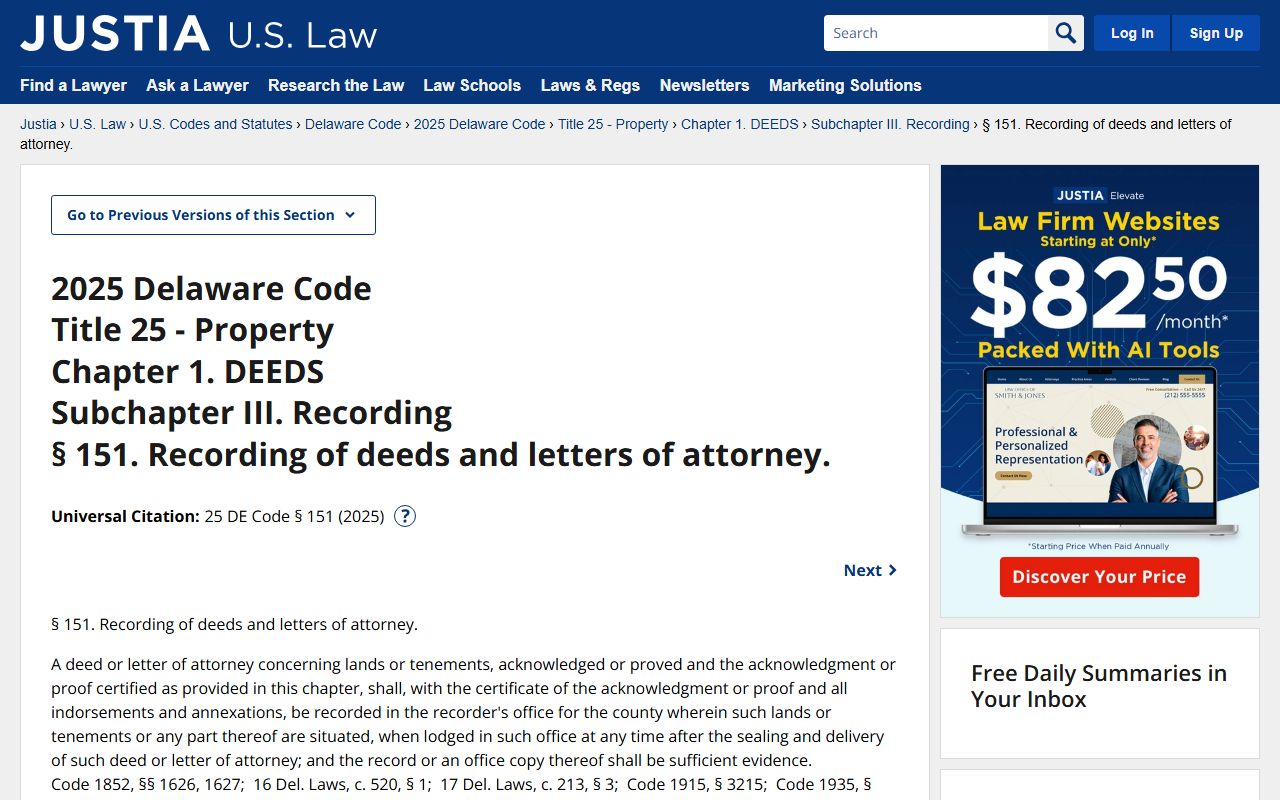 The statute says that once recorded, the deed serves as public notice. The record itself, or an office copy, counts as sufficient evidence of the transfer. This is why the chain of title matters so much. A gap in the record can cloud a sale.
Delaware law also sets standards for what the deed has to look like on paper. The recorder can reject any deed that does not list the tax parcel number in a conspicuous place on the first page. The deed has to show the words "prepared by" along with the name and address of the person who drafted it. Paper size must be between 8.5 x 11 and 8.5 x 14 inches. These rules keep the scans clean for the public search system.
Note: No Delaware recorder will accept a deed unless the seller signs an affidavit of residence and gain. The form is separate from the deed itself and must be lodged at the same time.
Delaware Recording Fees and Transfer Taxes
The cost to record a deed in Delaware depends on the county and the size of the document. Each county sets its own per-page fee on top of the statewide charges. The Brennan Title fee schedule breaks down the costs for every county in the state. 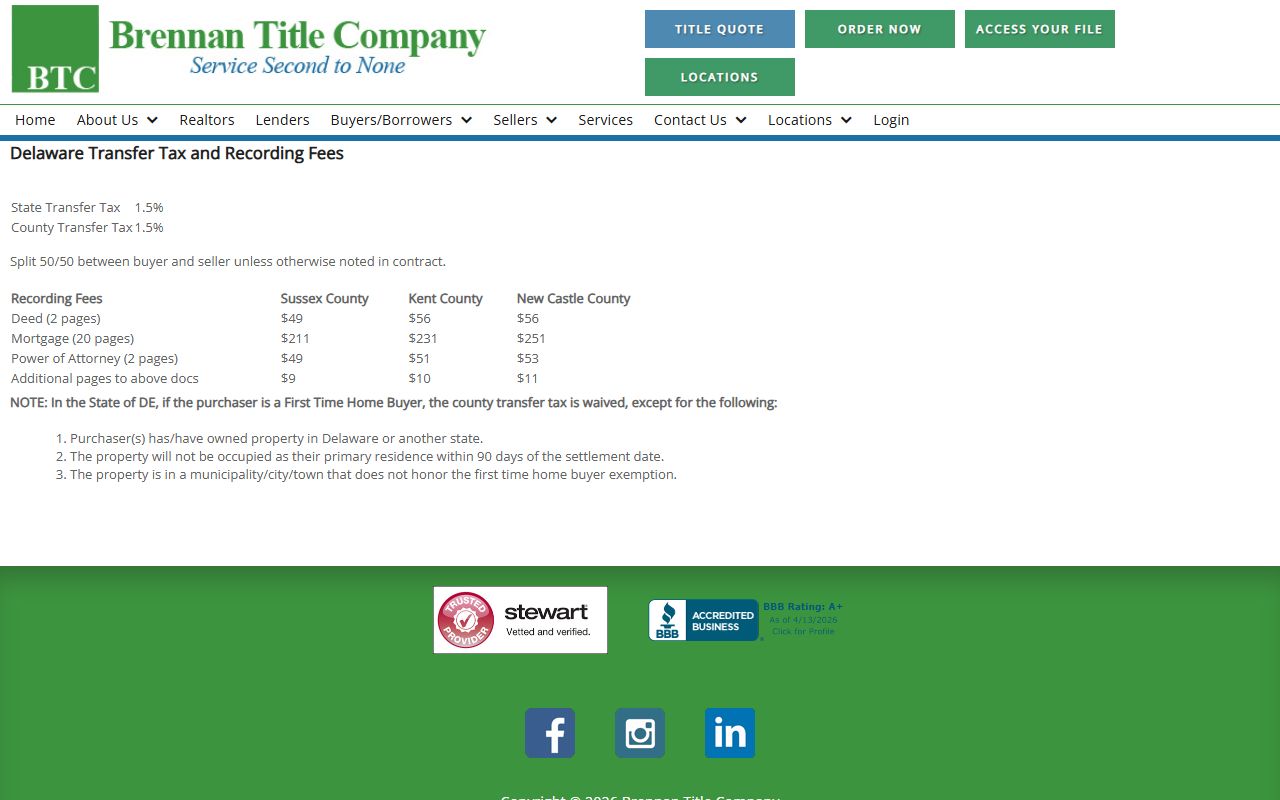 A two-page deed costs $49 in Sussex, $56 in Kent, and $56 in New Castle County.
Recording fees for longer documents:
- Mortgage (20 pages): $211 in Sussex, $231 in Kent, $251 in New Castle
- Power of Attorney (2 pages): $49 Sussex, $51 Kent, $53 New Castle
- Extra pages: $9 Sussex, $10 Kent, $11 New Castle
- Certified copies: $3 at the counter, $6 by mail
- Plat documents: $6 per page, $7 by mail
Delaware also charges a transfer tax on every sale. The state tax is 1.5% and the county tax is another 1.5%. That splits 50/50 between buyer and seller unless the contract says otherwise. In cities with a local transfer tax like Wilmington, Newark, or Middletown, the state share drops to 2.5% plus the city tax. First-time home buyers can get the county portion waived under Delaware law. The exemption does not apply if the buyer has owned a home before or if the property is not their main home.
The document fee is $30 statewide plus $5 for technology. Each additional page of a deed or mortgage adds $13. Each parcel description listed in the deed adds $3. These fees go to the county recorder who handles the filing, even though the state portion is collected on their behalf.
Transfer on Death Deeds
Delaware now accepts Transfer on Death deeds at all three county recorder offices. The new law lets a homeowner name a beneficiary who will get the real estate when the owner dies. No probate. No court step. The deed moves right to the named heir the day after death.
The law came from the Transfer on Death Act signed by Gov. Matt Meyer on Sept. 5. All three counties began recording the new form on Dec. 5. The form is standardized across New Castle, Kent, and Sussex. Michael E. Kozikowski, the New Castle County recorder, led the group that finalized the paperwork. The owner keeps full control while alive. They can sell, transfer, or revoke the Transfer on Death deed at any time before death. The deed also overrides any conflicting terms in a will.
This is a big shift for Delaware estate planning. Before the law, real estate had to pass through probate or a trust. Now a simple recorded deed can do the same job at a lower cost. Most title companies and estate attorneys have already added the new form to their standard toolkit.
Historical Delaware Deed Records
Delaware deed records go back further than in most states. The first officially recorded land title is dated 1646, back when the Duke of York was proprietor of the colony. Early deeds were kept at the Court of Sessions. Some of the very oldest records, from the Dutch West India Company era, are in Albany, New York. Others from the 1673 to 1674 Amsterdam period ended up in Holland, Sweden, or New Amsterdam. Few records from 1638 to 1655 still exist.
The Delaware Public Archives chain of title research guide is the best place to start historical research. 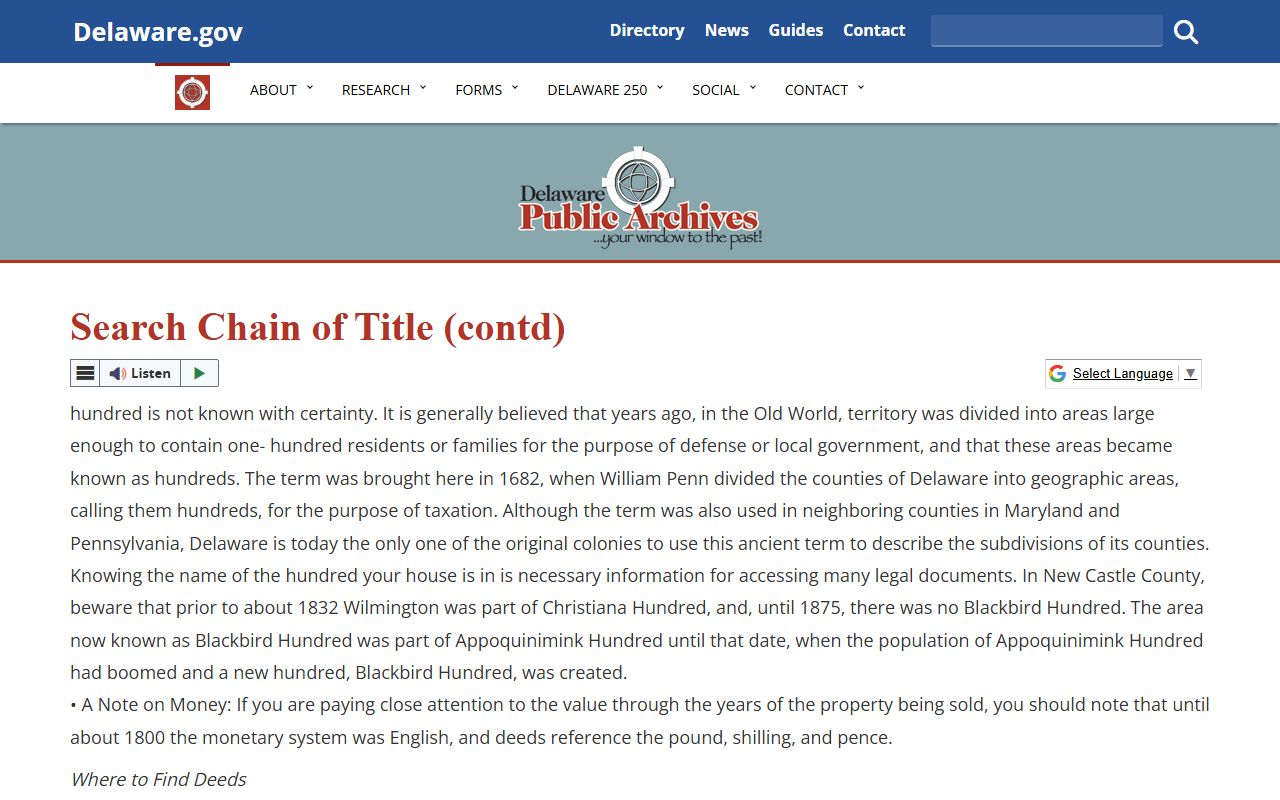 The guide defines the key terms you'll see in old deeds: GRANTOR means the seller, GRANTEE means the buyer, DIRECT INDEX lists grantors, and INDIRECT INDEX lists grantees. It also explains the "hundred" system, which is how Delaware counties divided land for tax purposes. In New Castle County before 1832, Wilmington was part of Christiana Hundred.
Old deeds on file:
- New Castle County deeds back to the 1680s
- Kent County deeds 1680 to 1850 (microfilm)
- Sussex County deeds 1693 to 1850 (microfilm)
The State Deed Records database at the Delaware Public Archives is searchable by grantor last name, grantee, property tract, and transfer date. 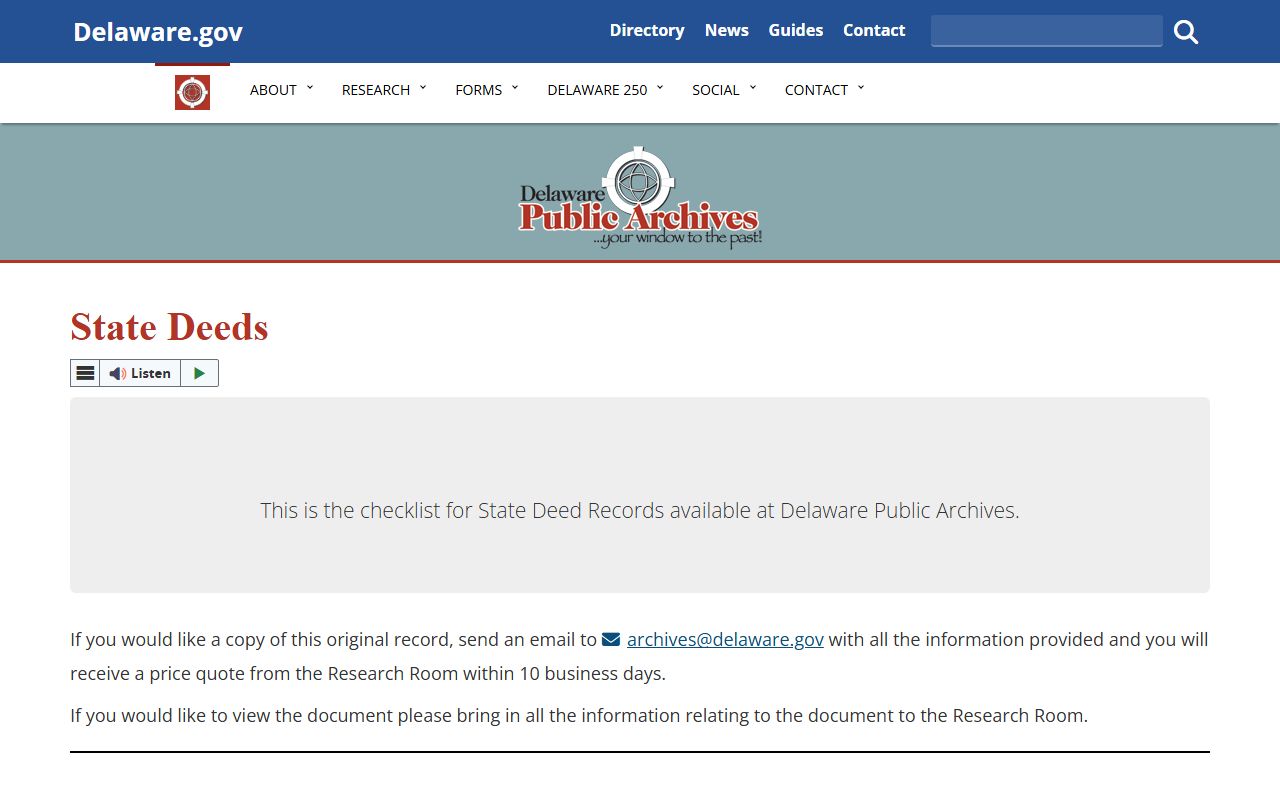 You can sort any of the headers and search the table right in the browser. This is the fastest way to find a colonial-era deed without making the trip to Dover. The University of Delaware also has a large collection of early deed records on microfilm.
How to Get Copies of Delaware Deed Records
Getting a copy of a Delaware deed record is easy. You can print one from the county's online system, pick one up at the counter, or ask for it by mail. The cost depends on how you order it. Copies printed from the online system are cheapest. Copies printed by office staff and certified copies cost more.
Typical copy costs across the state: self-service copy cards run $0.50 per page. Copies printed by recorder staff are $1 per page. Mail, fax, or email requests cost $2 per page. A certified copy costs $3 at the counter or $6 by mail. Plat documents are $6 per page at the counter, $7 by mail. Online printing is $2 per page for casual users. A $75 monthly subscription lets you download an unlimited number of pages.
Kent County and New Castle County both offer a Property Fraud Alert service at no cost. The Kent County Deeds and Property Records page walks through signup. 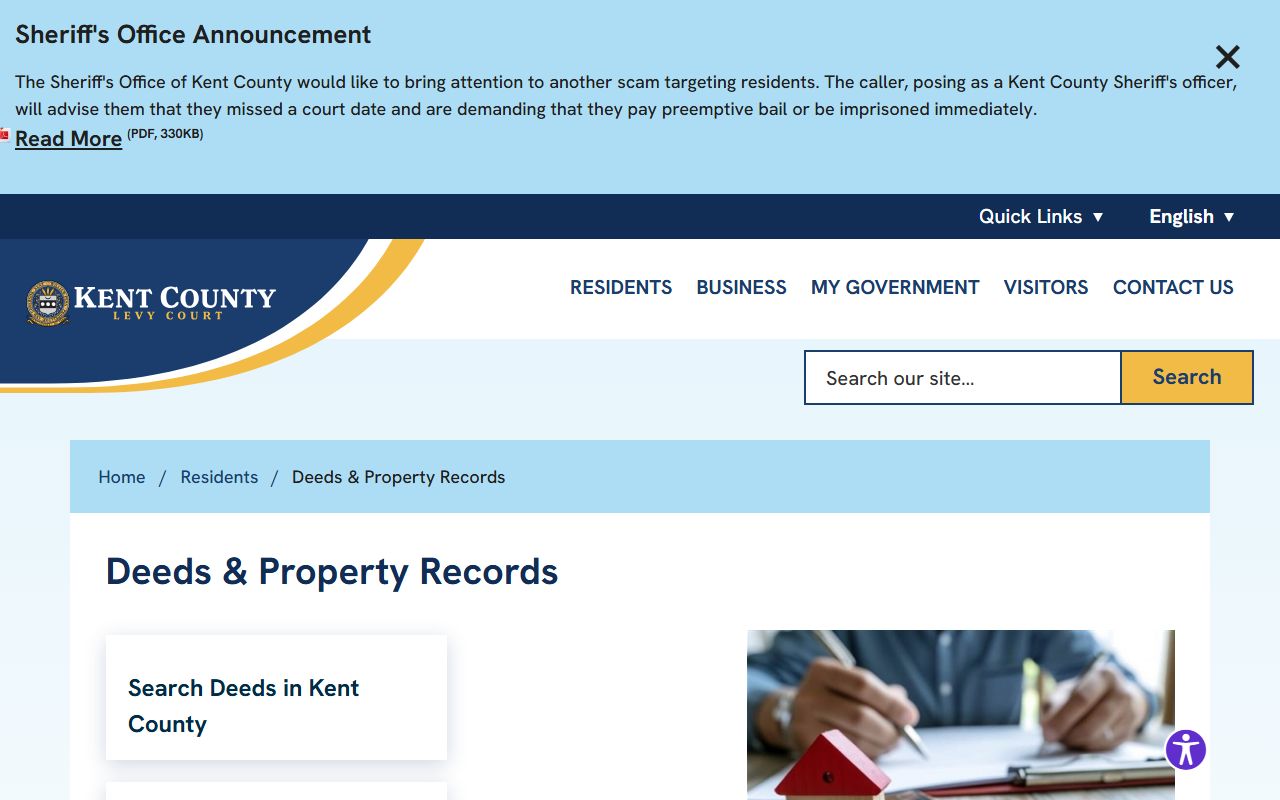 The alert sends an email any time a new document gets filed with your name on it. This helps catch title fraud early. Sussex County plans to add a similar service.
To request a copy by mail, write the Recorder of Deeds in the right county with the book and page number or the grantor name. Include a check for the fees. Include a stamped return envelope. Wait time runs one to two weeks. Most offices will confirm by email or phone if the payment is short.
Tip: Save money by viewing the deed online for free, then ordering a certified copy only when you need one for a title search, lender, or court case.
Are Delaware Deed Records Public
Yes. Delaware deed records are public under the state's Freedom of Information Act and under Title 9 Chapter 96. Anyone can search them. You do not need to own the property or give a reason. You don't need a lawyer. Free search is the rule, and most counties meet that rule with a watermarked view online.
Some parts of a deed file can be redacted. Social security numbers are removed. The new law allows anyone to ask the recorder to strike old race-based or religion-based covenants from a deed at no cost. Personal identifying information can also be redacted on request. These rules come from recent updates to Title 9 Chapter 96. County recorders have the forms ready at the counter and on their websites.
Most Delaware deed records are open to the public. Social security numbers and protected covenants can be redacted on request.
Browse Delaware Deed Records by County
Each Delaware county runs its own Recorder of Deeds office. Pick a county below to see local contact info, office hours, search portals, and fee details.
Delaware Deed Records by City
Residents of Delaware cities file deeds at the Recorder of Deeds office in the county where the property is located. Pick a city to see which office handles its records.